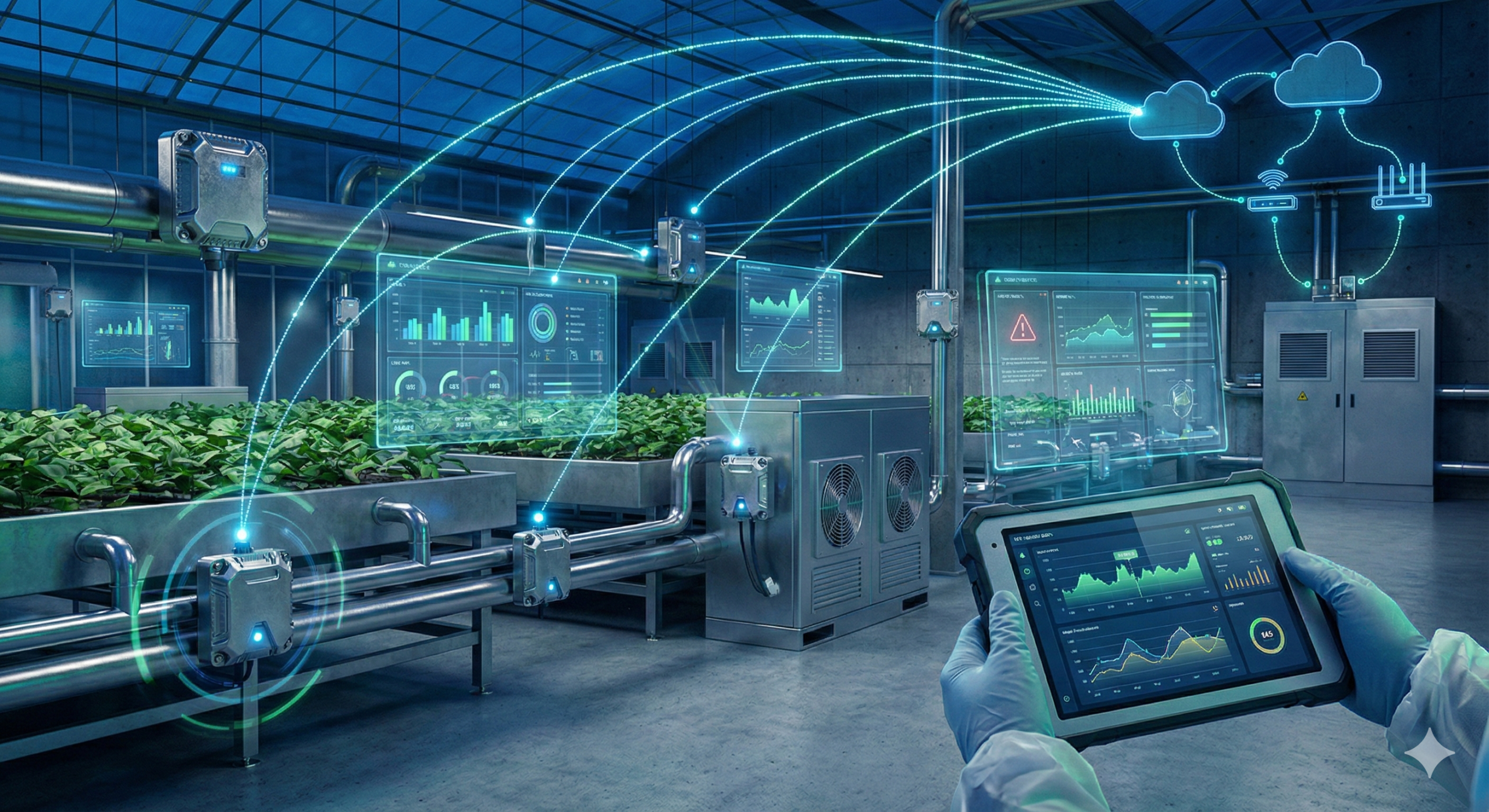
The adoption of the Internet of Things (IoT) is fundamentally changing how organizations approach data acquisition, moving from conventional methods to advanced, real-time operations. This article will delve into the essential concepts, advantages, and concrete steps for deploying a successful real-time data acquisition system with IoT technology, highlighting Axceta’s practical expertise in building solutions for these applications.

What is Real-Time Data Acquisition in IoT?
Real-time data acquisition is the process of collecting, processing, and analyzing data as it is generated, providing immediate insights into the physical world. In an IoT context, this involves a network of connected devices (sensors, actuators, and smart objects) that continuously monitor an environment or system and transmit data instantly to a centralized platform.
For example:
- Smart factories know in advance when a piece of critical equipment will fail.
- Greenhouses that automatically detect a sudden temperature drop.
- Cameras detecting minute defects in the quality of aerospatial parts.
- Automated scale systems detecting every ounce of material processed.
- LiDAR sensors give real-time insights into stockpiles of aggregate.
- Out-of-network, remote, mining pumps warning their operators when they are being activated.
These are but a few of the examples of real-world cases in which mission-critical information can be gathered to save costs and optimize operations in a plethora of domains.

Key Components of an IoT Data Acquisition System
The architecture of a robust IoT-based data acquisition system typically includes:
| Component | Function | Example |
|---|---|---|
| Sensors/Devices | Collect raw data from the environment. | Temperature, pressure, and humidity sensors |
| Connectivity | Transmit data using protocols (e.g., MQTT, HTTP). | Wi-Fi, Cellular (5G/LTE), LoRaWAN |
| Edge Computing | Process and filter data locally before transmission. | Gateway device with embedded processing unit |
| Cloud Platform | Store, analyze, and manage the vast amounts of incoming data. | AWS IoT, Google Cloud IoT Core, Azure IoT Hub |
| User Interface/Application | Visualize data and provide actionable insights to end-users. | Custom dashboard or mobile application |
The Business Imperative for Real-Time Data
Moving from batch processing to real-time data acquisition offers significant competitive advantages across numerous industries:
- Proactive Maintenance and Anomaly Detection: Real-time monitoring allows businesses to detect anomalies and equipment failures immediately, enabling predictive maintenance that significantly reduces downtime and operational costs.
- Optimized Decision-Making: Instant access to operational metrics empowers managers to make faster, more informed decisions, leading to optimized resource allocation and increased efficiency.
- Enhanced Customer Experience: In logistics and retail, real-time tracking provides accurate updates on product location and availability, leading to greater customer satisfaction.
- Compliance and Safety: Continuous monitoring ensures systems are operating within safe and regulatory parameters, automatically triggering alerts if thresholds are breached.
A Typical Step-by-Step Implementation by Axceta
Here at Axceta we know that a successful real-time IoT data acquisition system requires careful planning and execution. Our approach is based on four main phases that we will execute upon quickly, the main goal being that by completing these four steps, we will be able to deliver actual valuable and actionable data that your organisation will be able to use to save costs and optimize your operations as fast as possible.
Step 1: Planning and Design
Every business and its processes are distinct; even within the same industry, no two organizations operate identically. This implementation phase is crucial, as we will become de facto subject matter experts in your specific operations. This deep understanding allows us to fully master and address the unique challenges facing your organization.
- Define Objectives: Our initial step will be to establish a deep and precise understanding of the data required for collection and the specific business challenges it will address within your organization.
- Select Hardware: Selection of sensors and gateway devices will be tailored to your specific data needs and operating environment. For instance, industrial settings will necessitate the use of industrial-grade equipment to withstand harsh conditions.
- Architecture Mapping: Next, the data flow will be designed, encompassing connectivity protocols and the chosen data storage platform.
Step 2: Deployment and Configuration
After collaborating with your organization to pinpoint the essential real-world data points, we will proceed with the on-site deployment of the requisite equipment—including sensors, cameras, and connection gateways—to facilitate real-time data access.
- Device Installation: Once we have selected the hardware necessary to capture your real-world physical data we will strategically place and install all sensors and gateways so that we can capture said data at the targeted site.
- Network Setup: We now need to configure the network to ensure secure, reliable and low-latency communication between devices and where the data must be stored.
- Platform Integration: Our team will then configure or build the platform (e.g., data ingestion pipelines, storage databases) to receive the incoming streams of data according to your needs and domain.
Step 3: Data Processing and Analysis
With the necessary equipment now actively collecting data on-site, the next critical step is ensuring your organization can effectively utilize and interact with this gathered information.
- Develop Processing Logic: At this point we have the data but we need to implement logic for data cleaning, filtering, and aggregation, often performed at the edge (on the on premise equipment) or immediately upon remote (cloud or data center) ingestion.
- Implement Real-Time Analytics: The next step is to make the real time data useful by leveraging streaming analytics tools to process data in motion and generate instant alerts or insights.
For example, a system could detect a temperature spike and trigger an alert instantly. - Build Visualization Dashboards: We then create user-friendly dashboards to display real-time metrics, allowing key stakeholders to monitor performance, sometimes our clients already have a solution in place for this such as an ERP, in which case we will integrate the insights we generate for you there.
Step 4: Maintenance and Scaling
Finally, essential monitoring and robust security measures must be implemented to maintain the solution’s strength and security, focusing primarily on ensuring continuous operational availability of the tools and data.
- Monitoring: The required infrastructure will be deployed for continuous system performance monitoring, which includes regular checks on sensor battery life, connectivity status, and overall data quality.
- Security Audit: We will conduct a review and the necessary updates of security protocols to protect sensitive data streams.
- Scaling: We will ensure that the system is able to handle increasing volumes of devices and data as the business or operations grows.

Real world use case we delivered using this methodology
Here is a real world example and breakdown of these steps on a specific project Axceta helped on, specifically in the case of LithologIQ mobile core sample laboratory. This is a deep dive explaining what happened with this specific project step by step.
| Steps | What was done? |
|---|---|
| Step 1: Planning and Design | Define objectives: We partnered with LithologIQ to gain a deep understanding of their goals, business objectives, and challenges. Their vision was to revolutionize the mineral core sampling analysis process using portable hyperspectral cameras, dramatically cutting down the time required from weeks to mere hours. Select hardware: LithologIQ had already identified the specific sensors required for their project. Axceta planned the initial integration of the critical sensors with Edge compute modules and the PLC controlling the various actuators of the system. This equipment was selected to seamlessly coordinate with LithologIQ’s chosen hardware, enabling control over both the data capture process and the conveyor belt system used to move core samples beneath the cameras. Architecture Mapping: Our approach involved creating a comprehensive plan for hardware management, data delivery, and processing using specialized software. This strategy was designed to achieve near-immediate results from the scanned minerals.We understood that this plan would require adaptation as new information emerged throughout the project’s lifecycle. |
| Step 2: Deployment and Configuration | Device Installation:
Our primary role in this project was to leverage our existing teams, development environment and methodology to accelerate the conception of a functional, field ready laboratory. The mechanical and automation aspects of the project were done by a specialized partner so we focused on delivering an initial version of the software and collaborating with LithologIQ’S growing software team. Network Setup: The challenge in this unique scenario was managing the connection to a mobile laboratory operating in extremely remote areas. Since conventional network access was unavailable for real-time data transfer, an unconventional solution was necessary to acquire the data on-site and then transmit it externally once connectivity was established. Platform Integration: We focused on delivering, as quickly as possible, a minimally viable platform capable of ingesting and storing equipment-generated data. This system enabled the configuration of data capture sequences tailored to user preferences and specific domain challenges. It served as a strong basis for LithologIQ to evolve their further development from. |
| Step 3: Data Processing and Analysis | Develop Processing Logic:
The data acquisition method was established, but the collected information required storage and accessible usage. Specifically, the system needed to record the timestamp of data capture and the ID of the core sample box being processed. Furthermore, it was essential to store and associate critical metadata, such as light calibration data, with the collected information. Implement Real-Time Analytics: For this use case, the hyperspectral data was generated line by line. Therefore, a method was required to assemble these individual files into a format that was both easy for humans to interpret and compatible with specialized software. This software, running on a secondary computer in the mobile lab, was necessary for further processing to identify essential minerals and chemicals within the core samples.
A secondary product was developed to aid geologists in interpreting the data. This specialized tool analyzes the output from the main equipment, assisting in the identification and navigation of the massive datasets generated from thousands of core samples. For this project, we designed the tool’s user interface and specialized navigation features to allow for simultaneous visual consultation of vast amounts of hyperspectral bandwidth data. |
| Step 4: Maintenance and Scaling | Monitoring:
The core focus of this R&D project was the development of a new product, with a primary concern for data integrity. To ensure that no mission-critical data was lost during the acquisition process, we implemented solutions that immediately alert the user if any malfunction occurs. This allows the user to review their last operation and prevent data loss. Furthermore, a detailed log system was put in place to enable thorough auditing of all equipment operations. Security Audit: The system for this product operated as a closed loop. While security was a consideration, extensive work in this area was not required beyond ensuring the integrity of our codebase and development tools.
Scaling: Axceta ensured the client’s future expansion by delivering high-quality documentation and code bases, enabling them to construct a second mobile laboratory unit independently. Furthermore, we empowered their in-house development team with training and expertise, allowing them to assume ownership of product maintenance and future improvements. |
The future of data is real-time, and the journey starts with a conversation.
Real-time data is rapidly becoming a cornerstone of modern operations. As industries shift toward smarter, more responsive systems, the ability to collect and act on information in the moment is no longer optional, it’s strategic.
If you’re exploring how to bring real-time IoT data into your operations, we invite you to connect, exchange ideas, and learn from what’s working in the field.
Axceta leverages its expertise in embedded development to deliver specialized solutions across industries such as agriculture, mining, and energy, focusing on reliable IoT device management, advanced communication protocols, and energy-efficient technologies.
If you’re interested in learning more about IoT or if you’re seeking a partner to help implement security solutions, you can reach out to us at https://axceta.com/contact/
To stay in touch and read more about our projects, subscribe to our newsletter at the bottom.


